
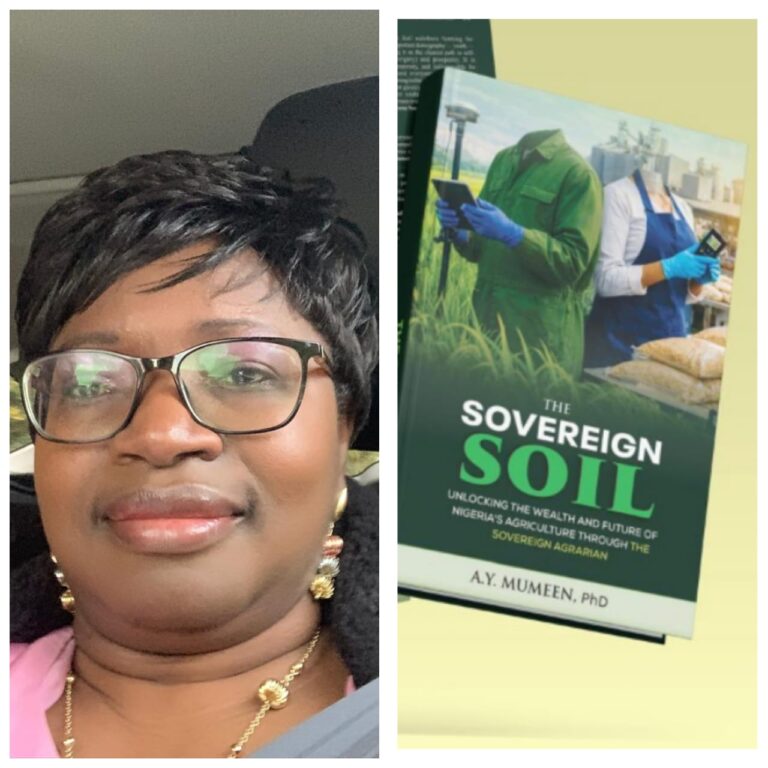
A United Kingdom-based legal practitioner, Victoria Oluwatoyin Opaleke, has described The Sovereign Soil: Unlocking the Wealth and Future of Nigeria’s Agriculture through the Sovereign Agrarian by Dr A.Y. Mumeen as a timely contribution to conversations around Nigeria’s economic development and agricultural transformation.
In a review of the publication, Opaleke commended the author for presenting agriculture as a practical pathway to wealth creation, entrepreneurship and national growth.
She said the book moves beyond traditional discussions about farming and positions agriculture as a key driver of economic transformation and innovation.
According to her, one of the book’s major strengths is its challenge to the long-held assumption that university education automatically guarantees employment.
She highlighted the opening chapter, The White Collar Myth, where the author examines graduate unemployment and encourages young Nigerians to explore agriculture and enterprise as alternatives for financial independence.
Opaleke also praised the author for drawing attention to Nigeria’s underutilised agricultural potential, particularly the country’s vast arable land and crop diversity.
She described the book’s analysis of Nigeria’s agricultural resources as revealing and necessary for repositioning the sector.
The legal practitioner further pointed to Chapter Three, The Hidden Middle, which explores opportunities in food processing, storage, logistics, value addition and agricultural market systems.
According to her, the chapter underscores how success in modern agriculture increasingly depends on technology, innovation and efficient systems rather than large-scale farmland ownership.
She also commended the book’s treatment of precision agriculture, fintech integration, digital farming tools, export compliance and other modern agricultural practices.
Drawing from her background in corporate law, Opaleke stressed the need for stronger legislative and policy frameworks to support agriculture.
She advocated improved alignment between agricultural policies and land-use laws, export regulations, environmental protections, research funding and youth development initiatives.
While praising the publication, she suggested future editions could pay more attention to women’s participation in agriculture, especially in areas relating to land ownership, access to funding and training opportunities.
Reflecting on the book’s impact, Opaleke said it altered her perspective on career development and nation-building.
She noted that earlier exposure to such ideas might have influenced her career considerations beyond the traditional professional pathway.
Describing the work as more than a publication on farming, she called it “a roadmap for national transformation” capable of repositioning agriculture as a profitable and technology-driven sector central to Nigeria’s future development.
She concluded by urging policymakers, educators, parents and young Nigerians to embrace the opportunities within the agricultural sector and support efforts to unlock the country’s full agricultural potential.