
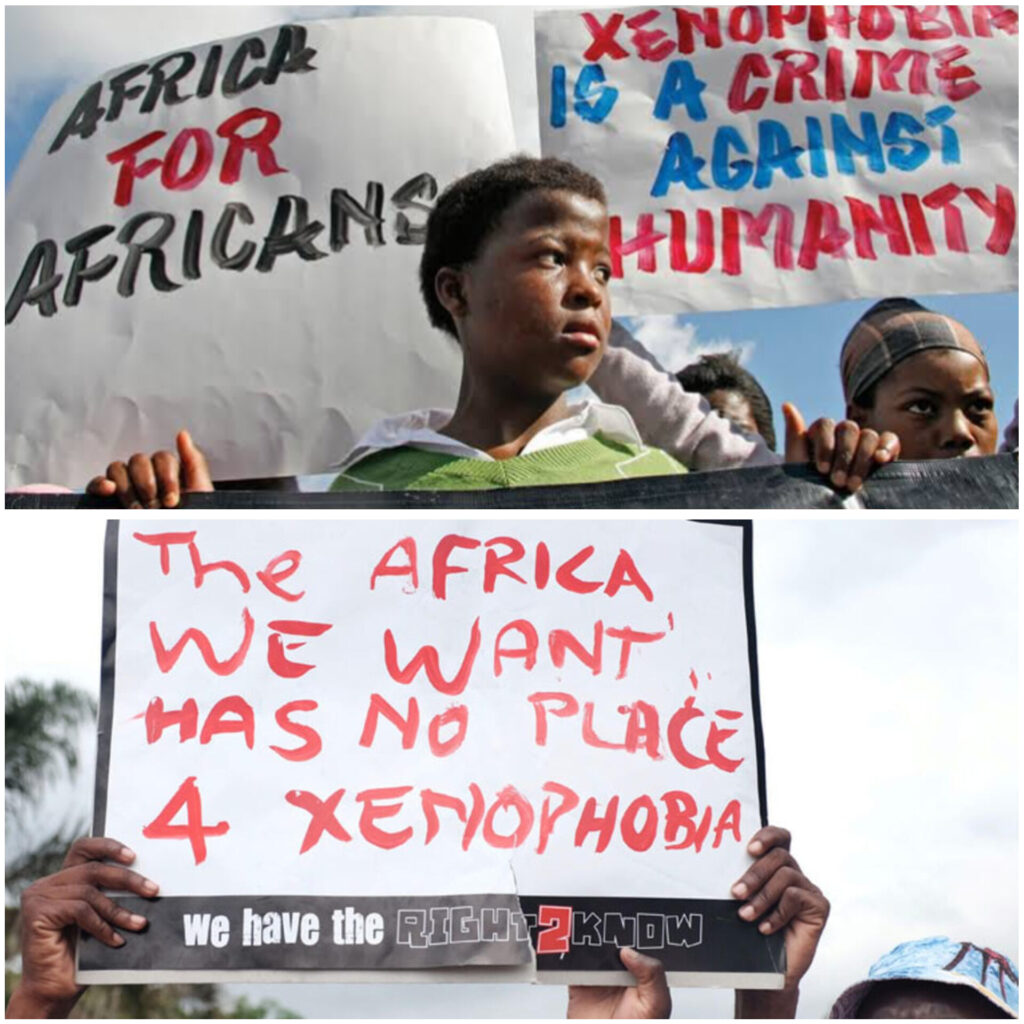
For centuries, Africa has spoken the language of unity, we have celebrated our diversity, embraced our shared history, and dreamed of a continent where borders would never become barriers. We call ourselves brothers and sisters, children of the same soil, heirs of the same struggle, and custodians of the same future.
Yet today, beneath one African sky… lie divided hearts.
The recent wave of xenophobic attacks in South Africa has once again forced the continent to ask a painful question: How does a brother become a stranger? How do people who once stood together against oppression now turn against one another? How does the shoulder meant to offer comfort become a bed of thorns?
These are not just philosophical
questions.They are questions written in tears, questions written in blood, questions written in the ashes of burnt businesses and shattered dreams.
According to reports, Nigerians, Zimbabweans, Ethiopians, Somalis, Pakistanis, Bangladeshis and several other foreign nationals have, over the years, become victims of recurring xenophobic attacks in South Africa. Businesses have been looted, homes destroyed, livelihoods erased, and innocent lives lost.
Behind every burnt shop is more than a building, it is a mother’s investment, a father’s retirement savings,a child’s school fees and a family’s only hope.
For many Nigerians living in South Africa, the dream was simple, to work honestly, provide for loved ones back home, and build a better future. Instead, many have found themselves running for safety in a land they once considered another African home. That is the greatest tragedy, not merely the destruction of property, but the destruction of trust and history makes this reality even more painful.
There was a time when South Africa’s struggle was Africa’s struggle.
When apartheid sought to divide and dehumanize millions, African nations refused to stand aside.
Nigeria, in particular, stood firmly with the South African people infact, our government established the Southern African Relief Fund through which millions of naira were contributed by ordinary Nigerians to support the anti-apartheid struggle. Nigerian students donated part of their allowances. Civil servants contributed portions of their salaries. Diplomatic pressure was mounted against the apartheid regime, scholarships were awarded to South Africans in exile, and Nigeria consistently used its voice on the global stage to advocate for justice and freedom. Those sacrifices were never made because Nigeria expected repayment.
They were made because Africa believed that when one nation suffers, the entire continent bleeds.
Today, that history feels almost like an old photograph, beautiful, but fading.
Perhaps this is why the recent attacks hurt so deeply. Betrayal has a peculiar sting.
The wound inflicted by a stranger may heal, but the wound inflicted by a brother often leaves a scar.
This is not about blaming an entire nation.
Millions of South Africans have condemned xenophobia. Many have risked their own safety to protect foreign nationals during attacks. Religious organisations, civil society groups and community leaders within South Africa have repeatedly spoken against violence and called for peaceful coexistence.
Their voices remind us that hatred does not represent the heart of every South African.
Yet, good intentions alone cannot comfort grieving families. Action must follow words, those responsible for violence must face justice, communities must reject the dangerous narrative that foreign nationals are enemies and the governments across Africa must strengthen cooperation to protect every African, regardless of where they choose to live or work. Because, the lives of Nigerians abroad matter and the lives of every African matter, justice delayed often becomes an invitation for injustice to return. Perhaps this moment should also challenge us to rethink what Pan-Africanism truly means.
African unity cannot exist only in speeches delivered at international summits.
It cannot survive merely in colourful maps or beautifully written constitutions.
Unity is tested not in times of celebration…But in moments of crisis.
It is easy to wave an African flag.
It is harder to protect the African standing beside you.
As Africans, we must decide whether our borders will continue to divide us or whether our shared humanity will unite us.
The African Continental Free Trade Area promises freer movement of goods and services. Surely, the movement of people deserves equal protection.
A continent cannot truly prosper if fear becomes the passport carried by its own people. The dream of Africa was never that Nigerians would fear South Africa, or that Ghanaians would fear Zambia or that Zimbabweans would fear Botswana.
The dream was bigger than that, it was a dream where every African child could cross any African border and still feel at home. Where our differences would become our strength, not our weakness and where our diversity would enrich us instead of dividing us.
There is another African proverb that says:
“The left hand washes the right, and the right hand washes the left.” This is entirely true because, no hand becomes cleaner by hurting the other, no nation becomes greater by humiliating another, no continent becomes stronger when its own children turn against themselves.
So, as we sympathize with every Nigerian who has lost a business…Every Ghanaian forced to flee…Every Zimbabwean who now lives in fear…Every African family mourning a loved one…
Let us remember that their pain belongs to all of us.
Because beneath one African sky, no life should be considered foreign.
And perhaps the day we begin to see one another not as competitors for opportunity, but as partners in progress,
will be the day Africa finally becomes the home our forefathers dreamed it would be.
But until then, we may share one continent,fly one dream and stand beneath one African sky. But our hearts will remain painfully divided.